Two side-by-side lines, neither moving faster. Families waiting for hours in the cold. A miniature mystery collectible and almost no story to take home. The Figma x Hello Kitty collaboration got the look right, but its New York City guest experience told a different story.
By Jahmela Smith | JSM CULTURE
New York City | November 7, 2026
Outside Figma’s Hello Kitty and Friends pop-up on Saturday, the first design problem was hiding in plain sight.
There were two lines. One for people who had RSVP’d, another for general admission. They ran beside each other and moved at the same time. People in one line had registered in advance, saved confirmation emails and arrived ready to show their QR codes. People in the other had simply shown up. From where I stood, neither group enjoyed a discernible advantage.
Farther along the block, toddlers cried while their parents tried to keep them warm. The queue wrapped around more than two city blocks. I arrived at 10:30 a.m. and did not enter the space until 1:11 p.m. That is two hours and 41 minutes spent waiting to step inside. Other attendees around me were also enduring waits of roughly two to three hours. The longer we waited, the more the carefully promoted promise of creativity and friendship began to feel disconnected from what was actually happening on the sidewalk.
I went because I wanted to love this event. I left with photographs I loved, an exceptionally tiny charm, and no desire to repeat the experience.
Figma and Sanrio had designed something worth looking at. What they hadn’t consistently delivered was something worth waiting for.
A collaboration that made sense, at least on paper
The premise was genuinely clever. Figma, the collaborative design platform, partnered with Sanrio to bring Hello Kitty and Friends into FigJam, its digital whiteboard. For a limited time, users could work with themed cursors, sticky notes and familiar characters. A physical celebration at 12 East 14th Street on November 7 and 8 would make the partnership tangible. The wider initiative also included a themed Lower East Side photobooth and more than 60 community meetups internationally. This was not a concept without ambition or resources.
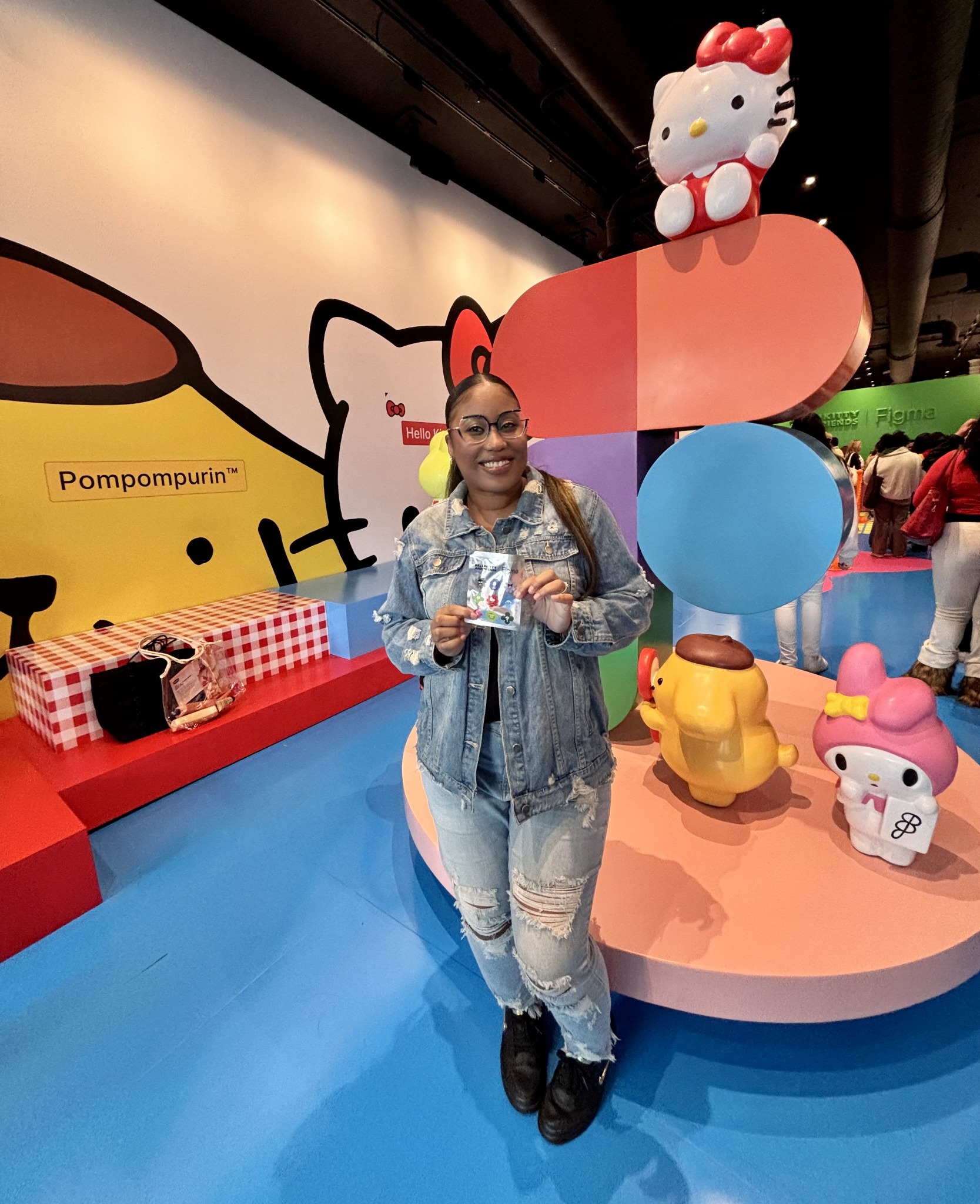
The aesthetic was pitch-perfect: giant Hello Kitty and Friends graphics, saturated color, sculptural blocks, character displays and a lime-green beverage truck topped by an oversized strawberry. The installation understood the emotional pull of Sanrio. It made a playful digital collaboration feel like a place you could enter, photograph and share.
It also had genuinely lovely touches. A few staff members were warm and welcoming. The collectible drink cups were appealing. The giant character murals gave the compact space a bold, joyful identity. Even the small surprise items were cute in their own right.
Those successes made the failures harder to overlook. When the visuals are this thoughtful, the parts of the experience that are not feel conspicuously unfinished.

Two lines, one unanswered question
The official RSVP page told guests to have a confirmation QR code ready at check-in. I had received two confirmation emails. Yet the registered line and walk-in line advanced simultaneously, with no observable timed-entry benefit, priority window or expedited check-in for those who had signed up. Registered guests were still being pressed to have QR codes ready while walk-ins progressed alongside them.
There is a necessary distinction here: Figma’s own announcement called admission first come, first served. RSVP never explicitly promised an express lane. My criticism is not that a written guarantee was broken. It is that the event established two separate admission categories without explaining any meaningful difference between them.
Registration can serve organizers by forecasting demand, collecting audience information and improving communication. Those are legitimate uses. But if that was its role, what purpose did the second line serve for guests? Why did one group have to produce QR codes when both appeared to receive the same priority?
The answer became more elusive when my QR code would not load. I explained that I had two confirmation emails. The representative I approached told me she could not verify the list and, in a brusque exchange, said she wasn’t good with technology. She did not offer to check another way or find someone who could.
I later learned that a woman with an iPad could, in fact, verify names on the guest list. The backup procedure existed. The representative I spoke to simply didn’t direct me to it.
Meanwhile, guests’ phones were losing battery life in the extended wait, and some were dying. A QR-code-based entry process that involves hours outdoors ought to anticipate dead phones, weak connections and emails that won’t load. The point of a backup is not just to have one. It’s to make sure every person working check-in knows how to get a guest to it.
The failure wasn’t necessarily the technology. It was the service recovery. And for a company that builds tools around intuitive collaboration, it was a revealing disconnect.
When a crowd becomes a test of endurance
Popular pop-ups generate lines. That alone does not make them poorly run. But it does place a responsibility on producers to manage the demand their marketing creates.
Outside this one, the lines snaked around blocks with sections that appeared insufficiently monitored. I watched people cut ahead of those who had been waiting. Along my section of the queue I saw no heating lamps, and I did not observe water being offered to people standing outside for hours. The cold felt more punishing as we approached the entrance.
What stayed with me most was not my own discomfort but the families. Young children were visibly overwhelmed. Parents tried to soothe screaming toddlers while the wait dragged on. This audience was hardly a surprise: the RSVP listing specifically invited parents to add up to two children or other guests to a registration QR code. At one point, people asked staff if women with small children, including some who had RSVP’d, could be allowed to proceed with priority. Many of us in line, myself included, were willing. The request was declined.
That moment did not call for abandoning fairness; it called for a thoughtful plan. A family-friendly event should have some clear, humane response when children are struggling. Priority assistance where appropriate, realistic wait estimates, weather contingencies and a supervisor able to exercise judgment are not extravagant demands.
Perhaps attendance exceeded projections. I cannot know the organizers’ internal numbers or staffing assumptions. But this was a free, limited-run event involving a globally beloved character franchise, social-media-ready sets and scarce giveaways. A substantial turnout should have been a serious planning scenario. RSVPs, social engagement, comparable-event attendance and venue throughput can all help organizers model it.
Timed arrival windows, a virtual queue, capacity updates, properly staffed line turns and a clearly marked family-assistance point could have made a difference. Even simply communicating how long the wait might be would have given parents an informed choice.
A two-block line may photograph like a marketing triumph. It doesn’t reveal what the people standing in it are feeling.
The small surprise and the much bigger expectations
The RSVP description promised “mystery boxes.” Figma’s separate behind-the-scenes story was more specific: mystery Sanrio character keychains to customize at a charm bar. Both described a surprise, but the first wording invited a different mental picture of the reveal.
“Mystery boxes”
Wording on the event’s RSVP listing. The item I received came in a small mystery package, not a substantial box.
My package contained a miniature character figure that became part of a charm, with accessories so tiny they were difficult to appreciate without holding them close. To my eye, the finished object’s scale felt especially underwhelming against the much larger imagery used to build anticipation around the experience. Miniatures have their own charm, of course. I wasn’t expecting a large or expensive giveaway from a complimentary activation. But after spending hours outdoors, the brief reveal and brief customization felt strikingly slight compared with the anticipation around them.
Inside, I saw guests exchanging characters because the mystery format did not let them choose their favorites. It was one of the most spontaneous, genuinely friendly interactions of the afternoon, and a glimpse of what this event could have encouraged more deliberately. A small trading station or guided exchange could have turned that instinct into a memorable part of the programming.
There was also no merchandise available for purchase during my visit. For collectors who might have wanted to bring home something else, the activation offered little beyond the limited complimentary takeaway and photo moments. The idea was cute. The actual experience was over almost as soon as it began.
The goodbye that never happened
What disappointed me most came after the charm was handed over: nothing.
No little card explaining the character or the collaboration. No thank-you note. No QR code accompanying the collectible to help a curious visitor discover more about the Figma and Sanrio project. No apparent invitation to keep creating with Hello Kitty in FigJam once the physical experience ended.
This was not a campaign without a digital story. Figma had made one. Its FigJam collaboration included character themes, creative tools and ways for friends to make things together. Yet the tiny object in my hand offered no bridge back to that larger idea.
A well-designed card, a collectible-specific creative prompt, a digital keepsake or even a simple note of appreciation could have turned the giveaway into an invitation. Instead, the handoff felt like the end of a transaction.
The souvenir was small. Its meaning didn’t have to be.

Matcha, miniature toppers and a guest journey with little flexibility
The lime-green truck outside was easily one of the activation’s strongest designs. The oversized strawberry and Sanrio illustrations made it impossible to overlook. Figma’s advance publicity described grabbing matcha or strawberry milk at the truck before going inside, but when I asked whether I could skip the charm activity and simply get a matcha, I was told that was prohibited. Guests had to follow the indoor sequence first.
With the line as long as it was, a beverage-only route might have given some visitors a reasonable alternative and helped distribute demand, assuming the site and staffing could support it.
And the matcha itself? I love matcha. This one wasn’t to my taste. I also asked whether it could be sweetened to my preference and was told no. I recognize that’s subjective, but hospitality lives in these small moments of choice.
There was another curious detail. Cold beverages received little decorative toppers in different colors; the hot drink did not come with one. I asked for a topper because I wanted to understand and experience everything the activation was offering. Perhaps there was a sensible reason involving cup design or temperature. If so, nobody explained it to me. Without that context, yet another part of the experience felt arbitrarily limited.


Beautiful sets still need rules, and people who can explain them
Inside, large geometric structures looked like photo platforms. I watched people stand on sections of the installation, only to be approached by an upset staff member and told that wasn’t allowed. Figma’s own production account describes tiered blocks designed for people to sit together. If standing was unsafe or prohibited, a clearly visible sign or short explanation on entry would have prevented the confusion. Guests should not be scolded for making a reasonable guess about how a space is meant to be used.

My interactions with staff were uneven. A few people were welcoming, friendly and genuinely pleasant. I noticed them, and they deserve recognition. But I also encountered and observed many others who appeared bothered by questions, spoke curtly or seemed intent on pushing people along. When I introduced myself as media and asked ordinary questions about the activation, several representatives could not answer them or direct me to anyone who could.
Identifying myself as media wasn’t a demand for preferential admission. I wanted to understand how the event worked. The problem wasn’t that every brand ambassador lacked an answer; no temporary staffer knows everything. The problem was the absence, in too many interactions, of a helpful next step.
I don’t know whether those representatives were exhausted, short-staffed or enforcing policies they had no authority to change. Some may have been. That is precisely why brand training, supervisor access and frontline support are essential. Guests experience a company through the people it places in front of them, regardless of their employer of record.
Scarcity can drive a line. It can’t manufacture affection.
Figma also promoted limited-edition sweatshirts and character patches for the first 150 visitors each day. The on-site giveaway was also described to me as an exclusive gift bag. Those premium gifts were first come, first served, not a privilege for people with RSVPs. I was told I could return on Sunday and try for one of the special giveaways.
I won’t. The possibility of another item does not justify repeating the commute and the uncertainty, particularly after an afternoon that made me feel my time had been poorly valued.
That is the business problem beneath this otherwise charming creative campaign. Free admission does not mean visitors invest nothing. They spend on transportation, organize schedules, bring children, stand in the weather and devote hours to showing up. The brand has invited an exchange: a consumer’s attention and effort for an experience worth remembering.
By its own terms, the campaign promised more than a piece of swag. It celebrated creativity, friendship and connection. Visually, it achieved that. Operationally, my visit fell short: ambiguous registration value, under-managed lines, limited cold-weather care, uneven staff assistance, inflexible participation and an unfinished goodbye.
The customer relationship that never began
What was supposed to happen after I left? That is the question I kept returning to, because an activation should do more than make a brand visible for one afternoon. It should give people a reason to care about the brand tomorrow.
Figma succeeded in getting my attention. I registered, traveled into Manhattan, arrived at 10:30 a.m., waited until 1:11 p.m. to enter, took part in the experience and documented it. But I left without a meaningful introduction to how I might use FigJam, without a collectible-linked invitation to explore the collaboration, and without a reason to come back. I was even offered the chance to return the next day for a premium giveaway, and I declined.
Not every activation is designed to produce an immediate sale. Awareness, community-building, product discovery and positive brand sentiment are also legitimate goals. I cannot know Figma’s internal conversion targets or what follow-up it may have planned. What I can assess is the journey I actually experienced: attention was earned, but my desire for further engagement was not.
It brought me into the brand’s world. It didn’t give me a compelling reason to stay.
The isolated shortcomings matter less than the pattern. A decorative topper withheld without explanation is not a major scandal. A tiny surprise isn’t inherently a bad gift. A long line isn’t necessarily poor marketing. But taken together, these details tell a story about a guest journey that wasn’t given the same sustained attention as the campaign’s look.
JSM CULTURE’s verdict
I admired the art direction. The partnership made sense. The truck, the giant murals, the character-themed cups and the few kind staff members were bright spots. I even appreciated watching strangers swap mystery characters, creating a little community on their own.
But I wouldn’t send a family with small children to stand outside for hours in the cold for what I experienced inside, particularly without knowing what the wait would be. Someone arriving at a different time may have had a better visit. My account is not a survey of everyone who attended. It is a firsthand assessment of a campaign whose ambition was clear and whose execution, on Saturday, was not equal to it.
Sanrio’s philosophy, “Small Gift, Big Smile,” captures why this matters. A gift does not need to be large to be memorable. It needs a moment of thoughtfulness around it.
Figma and Sanrio made something people wanted to see. The missing piece was making more of those people feel valued once they arrived.
The most important takeaway from an activation isn’t what guests can hold in their hands. It’s what they carry home in their memory.
Editor’s note: JSM CULTURE attended the Figma x Hello Kitty and Friends pop-up in New York City on November 7, 2026. This independent review draws on firsthand observations, original photographs and the event’s published promotional materials. Conditions and experiences may vary by arrival time.