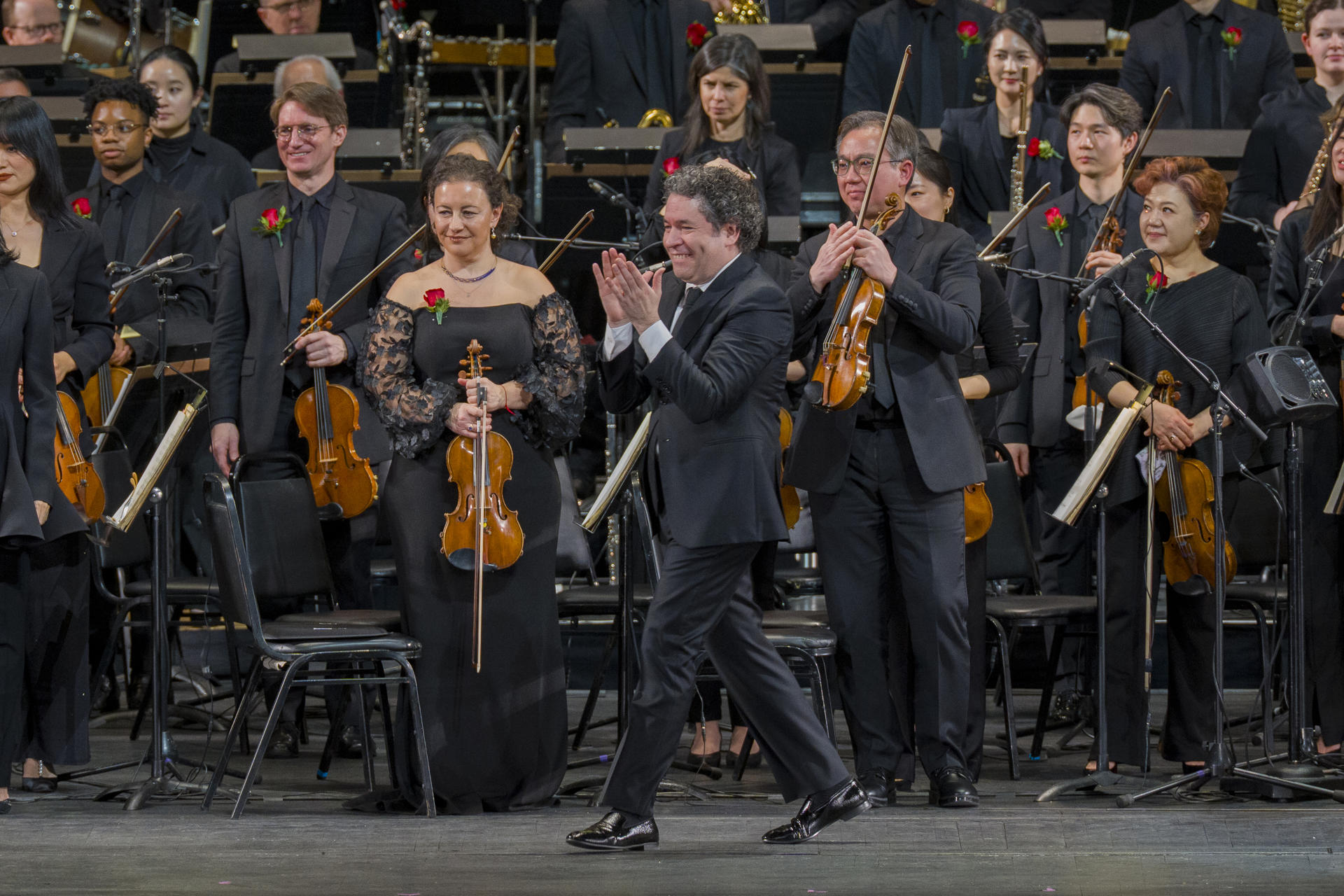
NEW YORK. Gustavo Dudamel could have begun his first season as music and artistic director of the New York Philharmonic with a traditional opening-night message: great orchestra, great hall, great repertoire.
Instead, the season kickoff at Radio City Music Hall was designed as a crossover event.
The September 10 kickoff was built around special guests Lizzo, St. Vincent, Aaron Tveit and Joaquina, with Liev Schreiber hosting. The announced orchestral program included music by George Gershwin, Philip Glass, Jessie Montgomery and Arturo Márquez, presented with Sphere Immersive Sound.
That combination makes the opening feel less like a classical-music ceremony and more like a declaration of audience intent.


Radio City changes the message before a note is played
Venue choice communicates. Radio City Music Hall is not the Philharmonic’s usual home. It is a New York entertainment landmark associated with spectacle, popular culture and the scale of a citywide occasion.
Putting an inaugural-season celebration there broadens the frame. The evening is still about an orchestra, but it is also about how that orchestra wants to be seen by people who may not think of themselves as regular classical-music patrons.
Gustavo Dudamel introduces his inaugural New York Philharmonic season and the artistic vision behind the new era. Video: Gustavo Dudamel official channel.
The guest list is a programming argument
Lizzo can move between pop performance and classical flute. St. Vincent brings an art-rock audience. Aaron Tveit represents Broadway. Joaquina brings a younger Latin-pop audience into the mix. Those choices do not erase the orchestra’s identity. They create more entry points into it.
Cultural institutions often say they want new audiences. The harder question is whether their programming, venues and presentation actually give those audiences a reason to believe the invitation is meant for them.
The opening week also makes clear that accessibility is not the only message. On September 11, Dudamel and the Philharmonic move downtown to the Perelman Performing Arts Center for a 25th-anniversary memorial concert featuring the Soldiers’ Chorus of The U.S. Army Field Band and a program that includes Barber, Villa-Lobos, Bernstein and the world premiere of We the Living, a New York Philharmonic commission. The sequence from Radio City spectacle to Lower Manhattan remembrance shows a first week designed to meet New York in more than one emotional register.
Technology is part of the repositioning
The use of Sphere Immersive Sound adds another layer. The promise is not simply that the orchestra will sound good. It is that the physical experience of the room can feel technologically contemporary.
That matters in a city where every live institution competes against concerts, sports, theater, nightlife and an endless stream of digital entertainment. Tradition alone is not a distribution strategy.
Why this matters now
Dudamel’s New York era will ultimately be judged over years, not one opening program. But first impressions reveal priorities.
This one says the Philharmonic does not have to choose between seriousness and accessibility, or between orchestral identity and popular culture. New York already lives at those intersections.
The opportunity is to make the orchestra feel like part of that living culture rather than a separate world people need special permission to enter.
Sources: Radio City Music Hall / MSG · Gustavo Dudamel official schedule.