The hardest part of a first-year event is that there is no ghost from last year telling you what to do.
At the inaugural New York High Academic Showcase, presented by Attitude of Gratitude, SLAM and Five-Star Basketball, that was the real assignment. Not just check people in. Not just move games along. Not just sell merch or hand out meals. Build the rhythm of something that had not yet built its own muscle memory.
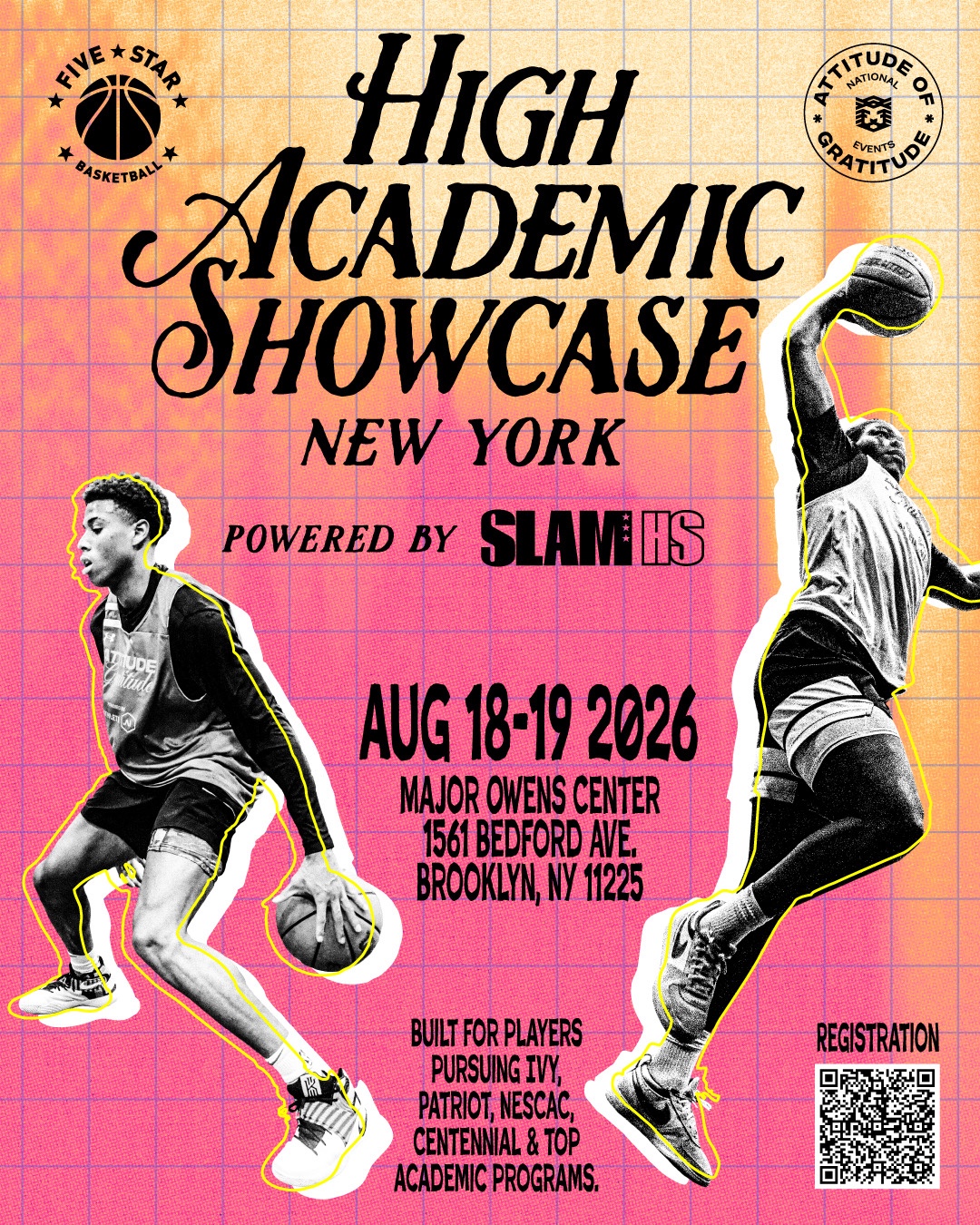
The public version was simple enough to understand: a two-day showcase at Major R. Owens Health & Wellness Community Center in Brooklyn, built for high-academic student-athletes trying to compete in front of serious college programs. The event listing promoted more than 200 student-athletes, 100+ college coaches and schools across Ivy League, Patriot League, NESCAC, UAA, Centennial, Liberty League and NEWMAC programs.
The operations version was more complicated: three courts, 24 teams, registration waves, payment questions, family arrivals, uniforms, meals, merchandise, skills work, games, speaker sessions, scorekeeping, clock management and a building full of players who needed the day to feel organized enough for them to focus on basketball.
Inside the inaugural showcase


JSM CULTURE firsthand images from the inaugural 2026 New York High Academic Showcase in Brooklyn.
Attitude of Gratitude belonged in the story.
That name matters. Attitude of Gratitude is not just a logo on a flyer. It gives the event a different emotional center. A showcase like this asks families to invest money, time, travel, hope and trust. It asks players to perform while being evaluated. It asks staff to keep the environment moving without losing the human part of why everyone showed up.
Gratitude shows up in the small things: greeting families like they matter, answering the same question without getting sharp, keeping meal distribution from becoming chaos, giving a confused parent a clear next step, treating a player’s day like it is bigger than a wristband or a roster sheet.
That is where the event had its strongest identity. It was not trying to be flashy for no reason. It was trying to create a serious basketball environment for student-athletes who are also thinking about school, opportunity, exposure and the next version of their lives.
A showcase is judged by flow.
When a basketball event works, people often describe the games. When it struggles, people remember the lines, the confusion, the missing information and the dead space between moments.
That is why flow mattered so much here. Three courts running at once means every delay can echo. A late start on one court affects parents, players, coaches and the next block of programming. A meal handoff that is not organized becomes a crowd-management issue. A merch table without a system becomes a bottleneck. A scorer’s table mistake can change the temperature of a game.
My role touched the places where the event could either feel controlled or start to fray: athlete and family registration, check-in, payments, issue resolution, meal coordination, merchandise, court timing and operating the clock under a 40-minute running-clock format. That is not background work. That is the work that lets the basketball stay in front.
The room was bigger than basketball.
The best part of the showcase was seeing how many ambitions were moving at once. Players wanted to compete. Parents wanted to know the investment meant something. College coaches wanted to evaluate. Organizers wanted a first-year concept to feel credible. Staff wanted to make the day easier than it could have been.
That is the real pressure of an academic showcase. The product is not only the game. The product is trust. Trust that the schedule means something. Trust that the players will be seen. Trust that the room is serious. Trust that the brand names attached to the event are matched by a standard on-site.
Speaker moments added to that standard too. David Hollander of NYU and Harry Rafferty of Phillips Exeter brought different perspectives on basketball, education, leadership and opportunity into the room. That gave the showcase more dimension than a basic weekend run. It told players that the goal was not just to be noticed. The goal was to be prepared for what comes after the evaluation.
What first-year events teach you
A first-year event will always reveal what the next run of show needs. That is not failure. That is the point. The first year teaches you where signage should go, where meals should land, how early check-in should open, which questions families ask most, where courts need stronger staffing, how to pace merchandise and which moments need more communication before the doors open.
What matters is whether the team pays attention. A good event team does not just survive the day. It studies the day. It turns stress into documentation. It turns questions into next-year systems. It turns a first attempt into a standard.
Before the whistle, before the highlight, before the coach takes a note, someone has to make the day work.
That is what this showcase reminded me. Basketball brings people into the building. Operations decide whether they trust the building once they arrive.
SOURCES: Five-Star Basketball New York High Academic Showcase listing; Attitude of Gratitude High Academic Camps listing; firsthand operations observations and original reporting.