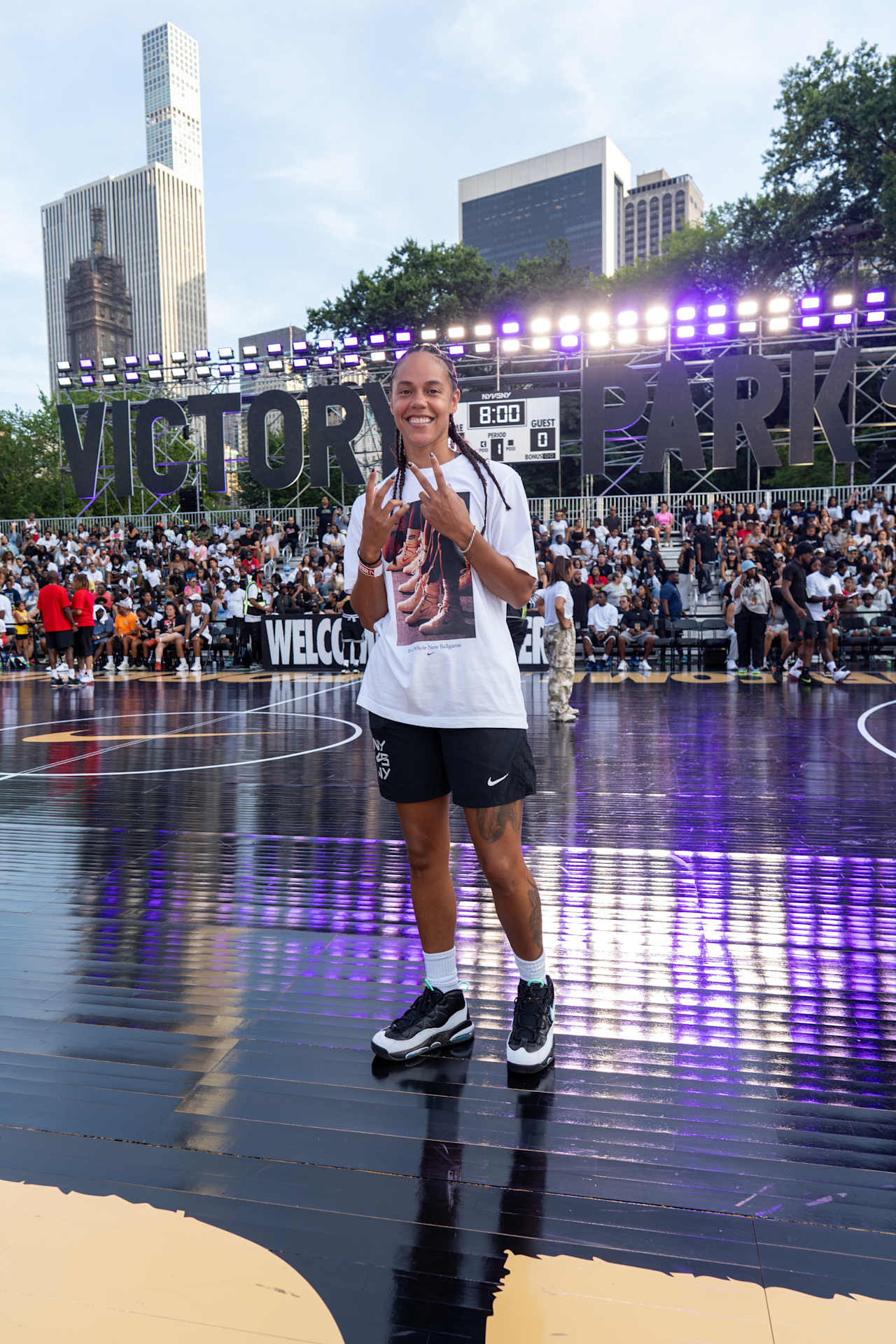
At Victory Park on 1800 Park Ave in Harlem, NYvsNY looked like New York showing off.
Not polished in a corporate-boardroom way. Better than that. The court sat under the train, wrapped in bleachers, lights, music, Foot Locker branding, Nike energy, kids, parents, creators, dancers, hoopers, cameras and people who came because the city told them something was happening.
From above, the build had the kind of visual language every city event wants and very few actually get. Hardwood dropped into Harlem like a stage. The words Where Champions Are Crowned stretched across the setup. The bleachers pressed close to the court. The train sat above it all like a reminder that this was not an arena pretending to be the city. This was the city becoming the arena.
People loved that view. You could feel it in the way phones went up before the games even settled in, in the way people looked down at the court like they had found a secret scene in the middle of Manhattan. The location gave the event texture. It gave it grit. It made the whole thing feel alive before the ball even moved.
But that is also where the lesson lives: the moment was bigger than the footprint.
The culture was already there.
NYvsNY does not have to convince anyone that New York basketball is culture. The city already knows. The players know. The parents know. The kids lining the gate know. The people coming for the shirts, the ice cream, the photos, the dancers, the music and the chance to say they were there know too.
Nike’s own event listing framed the finale as the place where “champions are crowned,” with doors, the Foot Locker Newsstand, VS. Market, a 3v3 Creator Takeover, middle school championships and the girls and boys championship games all stacked into one long day. GameChanger describes NYvsNY as Nike’s annual NYC summer tournament, now in its eighth year, built around neighborhood pride and the question of who really runs the city.
That is the right foundation. This is not just a bracket. It is a summer basketball ecosystem. It is park names, borough language, sneaker culture, music cues, family support, player dreams and New York pride in motion.
The best parts of the day understood that. The dancers gave it movement. The creators and influencers gave it social life. The giveaways gave people something to chase. The free ice cream mattered more than it sounds like it should because on a hot, crowded day, small gestures become part of how people remember the brand.
Victory Park, in motion


The finale pulled together New York basketball, fashion, media and neighborhood culture. Nike’s Street SNKRS coverage featured Jae Tips, Carmelo Anthony, Angelica D., Ashley C., Jarett W., Monica McNutt, Kashif Pratt, Rebecca D., RJ A., Taron Barnes, Tatiana B. and Walter H. The guest list added reach, but the young players and championship games remained the center of the day.


Victory Park Finals schedule · Nike’s complete Victory Park gallery → · NYvsNY games
The demand was real. The experience had to work harder.
The problem was not that people did not care. The problem was that too many people cared for the space, line system and guest communication to stay casual.
Long lines in extreme heat change the mood before a guest ever reaches the court. When people are pressed together, unsure if registration guarantees anything, unsure what they can bring in, unsure whether they can leave for food and come back, the excitement starts doing extra work against the friction.
Nike’s public event information did say registration was required and that registration did not guarantee entry because admission was first-come, first-served based on capacity. It also listed security rules, including no bags, no masks and hoodies down at entry. That information mattered. But on the ground, the experience still needed clearer signage, more repeated communication and a line journey built for people who were already hot, tired and trying to understand their chances.
Security should never have to become the main storyteller. Security can enforce rules. They should not have to explain the entire consumer journey at the gate because the event did not overcommunicate before guests arrived.
The check-in technology needed more backup too. When iPads are dying or moving too slowly, the line feels like it is waiting on a battery instead of moving toward a championship. For an event this visible, every entry point needed charged devices, backup devices, QR-code signage, printed backup lists, separate lanes and a clear escalation plan.
The regular fan has to feel included in the good stuff.
Giveaways are not just product. They are status. They tell people who the event sees.
That is why the distribution has to feel fair. When regular fans wait outside or leave empty-handed while celebrities, VIPs and better-connected guests seem to get the best access or best merch, it creates a split between the culture being celebrated and the people who actually carry it.
NYvsNY should have more public-facing drops next year, with timing, quantities and locations clearly communicated. Hold inventory for general admission. Create a kids-and-families allotment. Build in moments where the regular crowd has a real chance, not just whatever is left after the room has already been touched by access.
The merch opportunity is bigger than gifting. NYvsNY needs a real merchandise strategy: presale, preorder, day-of purchase, limited drops, team capsules, post-event online availability. People want to wear the memory. Let them.
Keep Victory Park in Harlem. Build bigger around it.
The answer is not to strip the event of what made it special. The answer is to respect how special it already is.
Victory Park on 1800 Park Ave should stay central to the story because the view was part of the magic: train above, court below, bleachers tight to the action, Harlem wrapped around the whole scene. But the footprint needs to meet the scale of the demand. Bigger does not have to mean less intimate. Bigger can mean smarter.
Next year needs more water before entry, more food options for a long tournament day, a family plan if re-entry is restricted, clearer prohibited-item messaging, better check-in redundancy, larger public space, an overflow viewing model, a fan zone, and a merch plan that treats the crowd as part of the event, not an afterthought outside the rope.
NYvsNY already has the culture. The next leap is making sure the consumer experience feels as legendary as the court.
That is the win and the challenge at the same time. The city showed up. The court looked unforgettable. The energy was real. Now the operation has to rise to the level of the view.
SOURCES: Nike Victory Park Day 5 event listing; GameChanger NYvsNY Season 8 information; Mato Victory Park Finale listing; TheNYBeat NYvsNY Championship Weekend coverage; Fubo NYvsNY boys championship listing; JSM CULTURE firsthand event observations.